
‘S-video outputs are not necessarily better than composite’

So says high-end cable maker AudioQuest (go here, enter the site, choose ‘Cable Theory’ and then page through to ‘2/10’ — oh I hate sites that rely on Flash Media for their entire content, rather than easily linkable HTML). ‘Necessarily’ is a weasel word. The fact is that an S-Video output implemented (on a DVD player) with no more than basic engineering competence will always outperform a composite video output. Some very well-engineered composite video processing circuits on display devices can do remarkably good jobs, producing quite watchable results, but they do this by dint of correcting and covering up the basic flaws in a composite video signal. See here to read how all this works.

Naturally, AudioQuest also offers power cables. The need for these is justified by the following:

The Challenge: The cable carrying AC power from a wall outlet adds distortion, and even the most sophisticated power supplies and filters cannot completely eliminate these upstream irregularities.

Every word of this is true. But that does not make it at all meaningful. The amount of distortion added by a few metres of power cable is immeasurably tiny, most likely even if you generated a pure 50 or 60 hertz supply with which to test it.

Of course, your wall outlet does not deliver a pure sine wave. Mine delivers power from a cable that connects my office to the house switchbox, through which it runs through a circuit breaker, which in turn is fed (via a supply fuse) from a wire hanging in the air to a power pole, which is in turn bolted to an exposed cable made of anything other than long-grain copper. This cable is also attached to thousands of electrical devices in other houses. It runs after a few kilometres to an 11,000 volt to 240 volt stepdown transformer (which, incidentally, is wired in delta configuration on the high tension side and star configuration on the 240 volts side).

That 11,000 volt line runs, after a few more kilometres of exposed wires, to a largish electrical distribution plant, where it is fed from another transformer which steps the supply down 330,000 volts. That is fed, in turn, by more than a hundred kilometres of cables hanging from large metal pylons to a hydro-electric dam which provides the bulk of the power. But at various points the grid to which all this is attached and with which it is synchronised is attached to other power sources: coal fired generators, gas fired generators, probably even some windmills out there somewhere.

And that’s only the ‘active’ cable. The ‘neutral’ cable is directly shared with three times as homes as the active cable because by using three-phase power, all the ‘neutral’ signals tend to more-or-less cancel out.

Somehow our ‘sophisticated power supplies and filters’ manage to cope with all this crap feeding into the power line, yet AudioQuest has the gall to suggest that reducing the immeasurably small amount of distortion created by a metre of cable between the wall socket and my amplifier will make some kind of audible difference. Yeah, sure. And all for just $US149.95 (one metre NRG-2 three core cable).

UPDATE (Thursday, 18 September 2003, 2:40 pm): The author of Number Watch emails:

What you say is true, but I think that you are too generous to them. They seem confused between distortion and interference, among a lot of other things. The term distortion cannot really be applied to AC power. A switching power supply works on square waves. The output of a full wave rectifier has an infinite-spectrum harmonic content, which is adequately dealt with by the tank capacitor and filter. Other sources of harmonic distortion are negligible in comparison.
Posted in Cables, Mysticism | Leave a comment

Latest Home Entertainment Dictionary update

A few more tens of hours, and a few more entries in the Dictionary of Home Entertainment. There are now 311 entries there, but I must confess that 77 of them offer little more in the way of explanation than ‘coming soon’. Still, I have finally been able to rid myself of my scrappy notes, and can work on filling in those missing definitions.

Those interested might like to look at my new, somewhat contrarian, entries on jitter and HDCD CDs.

Posted in Admin | Leave a comment

Magical speaker cables

Numbers Watch, which should be on the required reading list of anyone interested in the statistics constantly flung out by the media, draws attention to ‘a speaker cable with an integrated battery’ that apparently costs ‘just over ten thousand dollars’ (US, I assume). Unfortunately the explanatory link to which it pointed is now dead. But the other link points to a high-end cable maker, AudioQuest. A word of warning on the AudioQuest site: it’s all flash (that is, Flash Media), rather than good old HTML.

Now as it happens, I reviewed a couple of AudioQuest cables back in 1997, around the time I started all this hi fi reviewing stuff. They were the last cables on which I ever wrote reviews. At least one of the magazines I write for simply refuses to touch the stuff because of the controversy that is always generated. I can understand this. As a result of this 1997 review I was, or so I heard on the grapevine, black banned by the Australian distributor of AudioQuest products for a couple of years from reviewing the various products it distributed.

And here are the concluding paragraphs of the review that provoked this alleged reaction:

Okay, I confess to being somewhat of a sceptic in regard to high quality interconnect cables. But still it is my job to listen and report. Here is what I heard.

But firstly, some qualifications. AudioQuest claims that it takes time for the conductor/insulator interface to stabilise and recommends two weeks of running in. What with the first set of review samples being lost in transit and then me having to perform surgery on my preamplifier, I had about eighteen hours to use the cables before my review deadline. I left both sets of cables running for twelve hours with two CD players on repeat before trying to do any serious listening. I only hope that the Quartz was not unduly biased by its unrelieved exposure to Tchaikovsky’s 1st and Rachmaninov’s 3rd Piano Concertos, nor the Turquoise by carrying two Schubert Piano Sonatas without respite.

Another qualification is that I felt unable to perform the direct A-B testing I routinely do. This would have involved wiring up a fairly complicated switchbox which, given the necessarily subtle — if any — sonic differences for which I was listening, would have invalidated my results. So I had to listen sequentially: play some music several times, swap cables and play it again several times. Repeat the process over and over for different kinds of music.

Having disclosed my bias and given myself sufficient grounds for equivocation, what did I find?

My feeling is that on some kinds of music — especially very complex sound using a full frequency range (such as Rush’s Test for Echo), both the Turquoise and the Quartz gave a slightly more dynamic, punchier result. On small orchestral works, both cables again seemed to smooth the flow of music, to quieten and sweeten the violins. I thought I noticed a little more definition of a left of centre guitar in the Eagles’ Hotel California.

These results were obtained comparing the cables with a stock standard one metre RCA to RCA cable of the type given away with equipment. This cable was several years old. The differences were extremely subtle and I am by no means certain that they exist. These impressions could simply have been all in my mind. Between the Turquoise to the Quartz I could detect no difference.

So there you have it. I fear I’ve done nothing to resolve the cable controversy — neither in my mind nor in yours. It makes sense to use good quality componentry at every step of the audio reproduction process. Whether these cables are overkill is a matter for each listener to decide by auditioning.

But I can positively say that if you are looking for cables in the respective price ranges of the AudioQuest Turquoise [$AUS139 for the pair of half metre cables] and Quartz [$329] audio interconnects, you will be hard put to find finer examples of materials and construction. They are, simply, beautifully made and gorgeous to look at.

Personally, I think I was being rather kind. These days, with several more years of experience, and many examples of having myself exposed my own inadvertant self-deception, I have come to the conclusion that the differences I heard really were ‘all in my mind’.

Having said that, if you have those thin black cables connecting your bits of equipment, throw them away. What you should look for with interconnect cables are rather thicker ones that use real wound shielding (to ensure decent rejection of electrical fields in the vicinity) and, preferably, gold-plated plugs on the ends. The gold has no magical qualities, but its established physical qualities are that it is far less subject to corrosion than most metals. So once you plug your equipment in, your connections should remain trouble free for years.

If you frequently change your connections for whatever reason, you’re better off without gold because the mere act of plugging and unplugging generally cleans the connections and gold, being a very soft metal, wears away rather quickly.

But such cables are available for around $AUS20. There is no need to spend hundreds of dollars.

UPDATE (Sunday, 14 September 2003, 10:47 am): The author of Number Watch confirms that he was indeed talking about an AudioQuest product, known as the ‘Cheetah’. I leave it to the reader to consider the homonymic implications. I see that you can buy these interconnect cables, complete with their ’12V Dielectric-Bias System (DBS) pack’, for just $US900.

Posted in Audio, Cables, Mysticism | Leave a comment

Pioneer’s new Australian line-up

Pioneer Australia is flying me down to Melbourne tomorrow for the release of its new product line up. The company is strong in Plasma displays and DVD players, although its budget DVD Audio/SACD DV-655A is a disappointment (no real setup for DVD Audio or SACD).

I keep hoping that the next generation will deal with this problem.

Posted in Equipment, Testing | Leave a comment

AIX 8200: not quite a DVD-Audio test disc

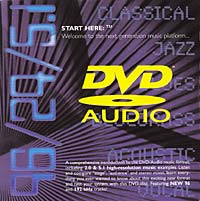
AIX 82000 Well, I remain on my so-far fruitless search for a DVD Audio disc with useful audio test signals. I had my hopes up for the AIX 8200 Start Here disc, which I just bought today from Rockian Trading for a reasonable $25. Rockian kindly throw in AIX’s first DVD Audio sampler as well.

Unfortunately the test tone don’t help me out. The reason? They’re all DVD Video test tones, not DVD Audio. This means that they are useful for aligning your surround decoder for playing back movies and music DVDs, but not for DVD Audio! You see, most DVD Audio players either do not perform speaker time alignment, or bass management, or both for the DVD Audio material. Their manuals tend not be explicit about this. Some just don’t mention it at all, while others mention it briefly in the notes somewhere within the manual. The only way you can be certain that your DVD Audio player does all this properly is to read one of the few carefully conducted reviews (most reviews don’t actually touch on this subject at all!), or to test it yourself.

It is because of these omissions in most DVD Audio players that many DVD Audio discs actually sound better playing back the Dolby Digital version of the material than they do the surround MLP version, at least in the great majority of real-world home surround systems.

Checking out these decoding capabilities with actual music recordings is a slow process, requiring me to find visually identifiable markers on recordings of the various channels’ analogue outputs. Looks like I’m going to have to keep on doing it this way for a while longer.

On the brighter side, the AIX disc has lots of music sampler tracks. The stereo ones, on a quick first listen, sound eerily like actually having the instruments in the room.

Posted in Audio, Testing | Leave a comment

InstaPundit notices Lileks noticing Sony

Things go in circles. InstaPundit comments on Lileks’ comments on Sony, and adds some observations of his own on Canon video cameras. As it happens, video cameras are not my strong point. I’ve only reviewed a couple over the years so I don’t really feel competent to remark upon them.

Posted in Misc | Leave a comment

Lileks notices Sony … and Sony suffers

The Bleat is a regular stopping point for me. As a professional writer myself, it brings me back to earth to read James Lileks, a writer who is, oh, at least three orders of magnitude better. Fortunately he doesn’t write primarily about my area. Whew! Still, sometimes he notices home entertainment equipment and this time Sony cops it.

I am bemused by his Sony ‘amplifier [which] has — groan — proprietary plugs for the speaker connections.’ I don’t think we have one of those here in Australia. Thank goodness. He is also ‘surprised that Sony movies don’t require the installation of a third eyeball, or perhaps a cochlear implant to pick up certain wavelengths of sound.’ Hmmm. How about SDDS? Are any Australian theatres outfitted for this?

Posted in Equipment, Misc | Leave a comment

A bit of activity

Well, last month this Web site scored a total of just under 4,400 visits, with 6,200 page views. The visits were up by 100% over the previous month and page views by around 50%.

The most popular content pages (ie. not counting the entry points and links pages) were this Blog (686, or 997 if you count the most popular archived page); the page on copy protected CDs (497), a short piece on Dolby Digital and DTS (427), the long-standing piece on video connection standards (370), a somewhat newer piece on progressive scan (357), a discussion of Superbit DVDs (219) and an explanation of anamorphic DVDs (133).

Early figures for this month indicate the Dictionary of Home Entertainment has made its way onto the top-ten list. I’ve added a few more entries, and a couple of photos to illustrate things. Still lots more to do though.

Posted in Admin | Leave a comment

‘RMS Power’ — an inappropriate term

Electronics professionals cringe when they see the terms ‘RMS Power’ or ‘RMS watts’ in publications. This new article explains why.

Posted in General Tech, Testing | Leave a comment

And now for the bad news: the rise of the Music DVD

Warner Vision Australia has issued a press release on the growth of DVD sales in Australia. The good bit:

… the DVD industry booming at 102% compared to the previous year (by unit growth) …This year, the DVD software market will generate expected retail sales of $860.8 million making DVD the fastest growing product format the industry has ever seen.

Strong hardware sales underpin this growth. By the end of 2003 there will be over 3.7 million DVD players in Australian homes, which is 43% of the 7.51 million households in Australia. This is almost double the number from 2002 and a far cry from the 89,000 units at the end of 1999. Estimates are for a penetration rate of around 60% by the end of 2004.

Yippee … lots of movie DVDs!

But here’s the bad news:

Music DVD as a genre is on the up and up, with a growth rate of 204% for the same period, which is double the growth rate of the total DVD market … Music DVD retail sales have grown from 6% in 2002 to 9.2% of the total market value for the same period.

The one saving piece of information about Music DVDs is that ‘Music DVD is around 3-5% of the total DVD market in the US, UK, France & Germany.’ That is, in the much bigger markets.

So why do I consider this bad news? Because I see it coming at the expense of DVD Audio and SACD.

Music DVDs are just DVD Video, except that they have concerts or video clips instead of movies. The sound is normally in Dolby Digital, sometimes in DTS and rarely in PCM. In other words, for most the sound quality is simply not as good as would be available from either DVD Audio or SACD.

The problem is that the main selling points of the high resolution formats is their sound quality, but the majority of buyers simply aren’t interested in these subtle improvements over the CD. So CDs continue to sell strongly and if people want DVD, they want the value-added video content more than what DVD Audio or SACD have to offer (even though the former can have video as well). I suspect the market will sort itself out eventually with the CD remaining the primary audio-only format, and DVD Video being the value-added format. Likely studio material will find its way onto DVD Video, with the audio accompanied by music videos where available, or lyrics and photos where not. Hopefully one of the audio tracks will be at least 48kHz/16 bit PCM.

As for DVD Audio and SACD? They’ll either remain specialty items with a very limited catalogue and distribution (when was the last time you saw either one in a major record store?), or they may die altogether.

Posted in DVD, Music | Leave a comment