
WIN TV goes HD in Canberra

Last night I went to the official opening of the new Bing Lee store in Fyshwick, Canberra. Nice store. I’ll be writing about that for Appliance Retailer sometime today (if you’re reading, James :-). There, one of the speech-makers disclosed that WIN TV (the regional version of Channel 9) had started high definition digital TV broadcasts that afternoon.

Checked it out today. Sure enough, it’s now on. Kind of. Actually, it’s only a loop of HD material (I think the same loop that Channel 9 used to use). But it is in 1080i and some of the detail is simply spectacular.

One interesting side effect, though, is increased ‘judder’. That’s nothing to do with WIN but with the 1080i. This shows 25 frames per second (50 interlaced fields, thus the ‘i’). Because the image is sharper than standard definition, camera pans and the like resolve the movement of detail more clearly so the pans become less smooth as you see the finely detailed image in one position, then slightly displaced one 25th of a second later, and again a bit later, and so on.

This is less likely to be noticed on most movies (when they get around to putting actual program material on) because competent cinematographers balance their shutter speed/aperture to ensure a small amount of smearing during pans and significant subject motion and this irons out the judder. (For an example of this, watch the opening moments of A Bug’s Life — as the ‘camera’ pans up over the mud flat, the sharp edges of this clearly clunk down bit by bit. Yet throughout most of the movie, particular on the characters, the computer programmers have introduced an artificial ‘camera smear’ to avoid this during character movement. Freeze the picture during fast motion and you’ll see this quite clearly.)

Anyway, for those in Canberra who have a high definition tuner and want access the new WIN HD service, you will need to adjust your digital TV receiver’s settings. The easiest way is to note on what station you receive the SD version of WIN (UHF Channel 65 or 788.5MHz for Tuggeranong and Western Creek, VHF 11 or 219.5MHz for those with direct reception from Black Mountain Tower), go into the receiver’s settings menu, select the ‘manual’ search option and key in the channel or frequency as appropriate, then hit search. The tuner will find two stations, entitled ‘WIN TV Canberra’ and ‘WIN TV HD’. These are generally numbered 8 and 80 respectively.

If you would rather re-do the whole tuning, I strongly suggest that you find the ‘Factory Reset’ option first and use this to zap all the current settings. Then when you do the scan you won’t double up on stations (some tuners don’t handle this at all elegantly).

Posted in DTV, HDTV | Leave a comment

DVD Recording convergence, or LG goes quad

For the last couple of years I’ve been arguing that the multitude of recordable DVD formats (DVD+R, DVD-R, DVD+RW, DVD-RW, DVD-RAM) do not threaten a repeat of the Beta/VHS wars of two decades ago. To put it simply, unlike the competing VCR formats, all recordable DVD formats fit into the same hole. All the rest is details.

LG DR4812W DVD recorder Previously my point has been partially proven by Sony’s DVD recorders, the RDRGX3 ($AUS1,399) and the RDRGX7 ($AUS1,699), which support DVD-R, DVD-RW and DVD+RW, and the Toshiba D-R1 ($AUS1,499 — DVD-R, DVD-RW, DVD-RAM), and any number of multi-format DVD burners for computers. But today a new consumer DVD recorder from LG Electronics has just lobbed into my office. The LG DR4812W supports four formats: DVD+R, DVD-R, DVD+RW and DVD-RW. By ‘support’, I mean it will record to all four of them. I haven’t opened the box yet, so I don’t know how well it does this, but this remains an impressive achievement. The price looks good too, at $999, and this includes a DV input which many entry level models don’t have. Okay, I just got it out of the box and it looks a lot more attractive than my picture implies, with a mirrored lower half. One downside on facilities: the back panel video input is composite video only. There is S-Video, but this is only on the front panel, which leads to ugly cabling if you want to leave it permanently connected to a digital TV receiver for recording.
Come 20 May, LG’s DR4922W will come out at $1,099. This one adds a slot for various flash memory cards.

Posted in Equipment, Recorders | Leave a comment

Euro-NTSC

The other day my brother, who is somewhat of an Austria-phile, was pondering his collection of DVDs of the annual Vienna New Years Day concerts. As he says:

Each year it is released on a different label although the content is always sourced from ORF (the Austrian ABC).1987 – Sony.
1989 – Deutsche Grammophon.
2000 – EMI.
2001 – Teldec.
2002 & 2003 – TDK.
2004 – Deutsche Grammophon.

The weird thing is that out of all of these DVDs both Deutsche Grammophon are in NTSC. The others have an NTSC version for the US and a PAL version for Europe. A quick check on Amazon.uk reveals all the DVDs released by Deutsche Grammophon are NTSC – but this is a German company??? Strange.

So why would Deutsche Grammophon do all its DVD releases in NTSC when it is a German company (Germany is not just a PAL nation, but the home of PAL). Here are a couple of possible explanations.

First, if a company wants to keep its inventory small by carrying just one format, yet sell in both Europe and the US, then it’s wise to encode NTSC rather than PAL. The reason is that the majority of TVs sold in Europe (and Australia) over the last ten years will display both PAL and NTSC, while most TVs sold in the US will display NTSC, but not PAL.

Ordinarily I’d say that DG still ought to provide us PAL-people the best possible quality (ie. PAL), except for one thing. If DG used film rather than video to record, then the transfer to PAL involves a 4% speed increase and, consequently, a 4% pitch raise (the 24 frames per second of the film are simply transferred, one-to-one, to the 25 frames per second of PAL video). Since DG is primarily a classical music record label, pitch accuracy may well be higher on its list of priorities than video resolution, so perhaps they chose to go NTSC for the sake of the audio. It is possible to do film to PAL conversions while preserving the audio’s pitch, but this can result in video that has the dual disadvantage of suffering from NTSC-like interlacing, without the redeeming feature of being effectively corrected by the enormous amount of equipment designed to minimise NTSC interlacing.

This argument doesn’t apply, of course, if the thing was captured in either PAL or NTSC video in the first place.

Posted in DVD, Music | Leave a comment

Universal also stuffs up on ‘anamorphic’ label

I was whinging earlier (and here as well) about MGM releasing low cost Region 4 DVDs in non-anamorphic widescreen, while claiming on their boxes that they are actually ’16:9′ (ie. anamorphic) transfers. Now, it seems, Universal is up to the same old trick.

The offending title this time is the well-regarded 1998 Elmore Leonard/Steven Soderbergh crime thriller Out of Sight. In Australia this title was first distributed on Universal’s behalf by Columbia TriStar. At the time I drew to the company’s attention some misleading suggestings in a very informative information screen on the disc (it is hard to find — you go to ‘Bonus Materials’, then select the right-hand pointy end of the yellow arrow above ‘Menu’. You will know you have selected it because the point will turn orange. Press ‘Enter’ and repeat on the next screen. Then choose ‘Technical Information’.)

Here are a couple of snippets from this:

Four D-1 component videotape submasters were “downconverted” from the OUT OF SIGHT HD master: NTSC and PAL 3:4 hard-matted widescreen, plus NTSC and PAL 16:9 which are the source elements for DVD release.

Well, it looks like we scored the 3:4 hard-matted widescreen, not the 16:9. It goes on to say:

The 5.1 master … was then transferred to the AC-3 Dolby Digital coding at a rate of 448kbits/sec via a Dolby 561B encoder.

Sorry, the PAL DVD uses 384kb/s.

Now the Columbia TriStar release of this title did not suggest on its cover that the DVD was an anamorphic transfer. But now that Universal has taken over distribution of its own titles, things have got worse.

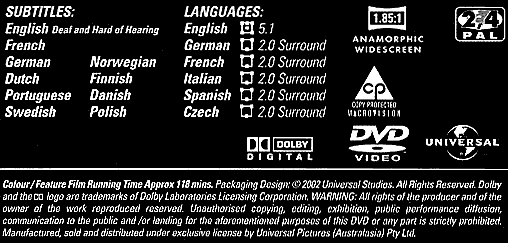
First, the DVD itself seems to be identical in every way to that previously distributed by Columbia TriStar. Yet the cover is different. Here is the disc information block in its entirety:

Disc information block for the Region 2/4 version of 'Out Of Sight'
Note, in particular, the aspect ratio claim near the top-right: ‘1.85:1 Anamorphic Widescreen’. This is wrong and misleading. The movie on the disc is in 4:3 hard-matted widescreen. The quality is, therefore, substandard.

Posted in DVD | Leave a comment

The Real Starship Troopers

There were many, many disappointments in Paul Verhoeven’s 1997 movie Starship Troopers. Those of us who love Robert A Heinlein’s novel object to the political re-orientation in the movie, the idiotic ‘science’ and the unbelievable contrivances used to have the characters stumble across each other at various points. One less objectionable, but still disappointing, omission from the movie was Heinlein’s ‘Powered Armour’. He clearly had a love affair with the concept. It was the device that made his Mobile Infantry mobile.

In recent years the US Defence Department’s DARPA (Defense Advanced Research Projects Agency) has been funding development of something very similar. Now, it seems, a working prototype of the leg enhancement and load-carrying part has been developed by the Berkeley Robotics Laboratory.

From the always-exciting FuturePundit article on the subject:

In the UC Berkeley experiments, the human pilot moved about a room wearing the 100-pound exoskeleton and a 70-pound backpack while feeling as if he were lugging a mere 5 pounds.

And this is only the first version.

Posted in General Tech | Leave a comment

Useful explanation of anamorphic widescreen

Many pieces have been written by many people attempting to explain, in terms accessible to the non-technical, what anamorphic widescreen is all about. I’ve had a bash at it myself here and here and, to some extent, here.

But this slide show Web site offers an exceptionally accessible explanation, well illustrated, that ought to be clear to anyone.

Thanks to my brother Mark, whose own Web site is full of excellent photographs of Canberra.

Posted in Video | Leave a comment

Dictionary additions and dialog normalization

Rod, mentioned in the post below, has also suggested I include ‘dialog normalization’ in the Dictionary of Home Entertainment. Good point, and it was something I shouldn’t have overlooked, so here it is. Naturally this required some other additions, so in went metadata and dynamic range control. Plus I’ve added slightly to Dolby Digital, and corrected a mistake (I had said it was originally developed for film, but of course it was originally developed for digital TV, but became famous through film).

My treatments of these subjects in the dictionary are necessarily short, but there’s some interesting Webbed stuff. In particular, this Secrets of Home Theater and High Fidelity piece is excellent while this SMR Home Theatre A/V Magazine piece also provides useful background, and raises the interesting issue of calibration.

If you read formal treatments of setting up home theatre systems, you will find that they always ask you set the channel levels using the test tone for an indicated 75dB on your SPL meter. This is something I never do. I usually use 70dB or 80dB. Why? Because the good old Radio Shack meter has +6dB on the extreme right of the scale, so if you set the dial to 70 and try to get everything at 75, the meter needle will spend a lot of its time pushed against the stop on the right hand side. I suppose it can take it, but I believe in respecting equipment (I have two of these meters, the first one I purchased some time in the 1970s and it still works fine!)

Also, because I don’t think that calibration to an absolute volume level is especially useful. For me the important thing is to have the channels calibrated properly relative to each other. What level I actually watch a movie on depends upon my mood, the circumstances and the equipment I’m using. If properly calibrated to an absolute level then, as the SMR piece makes clear, program peaks may reach 105dB. Actually, that’s 105dB per channel! Let’s do some arithmetic. If I’m reviewing some DynAudio speakers (which, as a rule, I simply love for their sound), I have to take into account their lower than average sensitivity. They typically come in around 85dBSPL (1 metre, 2.83 volts average pink noise bandwidth limited to 500-2,000Hz). Let’s say that the receiver I’m using can deliver 100 watts per channel. At my listening position of 2.7 metres from the front speakers, the volume for one watt (which is what 2.83 volts into eight ohms is) is actually less than 85dB. One hundred watts is 20dB more than one watt. So there’s no way that this system can reach the 105dB peak. Absolute calibration is not a good idea in such cases.

Or I might be watching a movie with gear that has plenty of headroom (say some Klipsch speakers with a sensitivity of 96dB driven by a Sony digital receiver producing 170 watts per channel), and the guy next door is mowing the lawn. So I turn it up louder than the absolute calibration level. Or I might be watching late at night and I need to have it down (two of my daughters came rushing out to my backyard office the other night from their rooms on the other side of the house, worried about the shooting and screaming they heard — but it was just me playing the start of Runaway Jury).

The SMR piece also mentions some calibration problems with some test DVDs. I did a quick check on some of mine. I agree with the piece that all calibration tracks really ought to be set for the official calibration level of -31dBFS (0dB dialog normalization). Here’s what I found:

  • Video Essentials: -27dBFS (-4dB)
  • The Ultimate DVD Platinum: -31dBFS (0dB)
  • DVD Spectacular (both program and test tones): -31dBFS (0dB)
  • Pearl Harbor (Region 4) THX Optimizer and program: -31dBFS (0dB)
  • Alien (from the new Quadrilogy set) (Region 4) THX Optimizer: -31dBFS (0dB), but -27dBFS (-4dB) for the movie
  • Manhunter (R1) THX Optimode and program: -27dBFS (-4dB)

The question is, though, whether those -27dBFS settings have any practical effect. Because everything is relative. If the test tones on Video Essentials, for example, were recorded at a 4dB higher level than those on the Ultimate DVD Platinum, then what difference does it make? The decoder should just turn them down 4dB. That’s something I’ll have to check when I have a spare moment.

Posted in Audio | Leave a comment

Is separate boxing for video switching necessary?

Rod, the chap who maintains the extremely useful Chopping List Web site (on movie censorship), asks:

While reading your informative A/V blog yet again, I was reminded of a question which you may be able to help me with. I have done some web searches but have not found any comprehensive info.The question relates to video switching. I currently use a Marantz AV9000 HT pre-amp as a processor. It has video switching for various formats, including composite, S-video and component. I’ve learnt that video switching may reduce audio performance, due to those circuits running at “higher frequencies”.

Ah hah, here is where I get to be heretical again. If the equipment manufacturer is not entirely incompetent, it matters not a whit that the A/V processor or receiver has video switching in the same box.

What damage can the video signal do to the audio signal? The transit of the signal could generate high frequency fields that in turn induce currents in the audio circuits. Solution: shield these sections of the circuits from each other. Could there be interference back through the common power supply? Sure. There certainly is (except where the switching is passive). As there is if the boxes are completely separate with their own power supplies. The important question is the level. Totally insignificant. Not measurable, not audible.

Marantz is most certainly not totally incompetent.

The video circuits do indeed run at higher frequencies. The bandwidth of a PAL or NTSC composite video signal is around 5MHz or a bit more (it’s considerably higher for high definition video). I haven’t checked out the power vs frequency spectrum of such signals, but let us assume that it is roughly even (ie. it’s very wide bandwidth pink noise), then the fact that it is high frequency is good. A video signal runs from virtually DC up to that 5-ish megahertz, so only a tiny proportion of it is in the audio bandwidth. Even if you take the audiobandwidth to extend to 100kHz, that still means that only 2% of the low voltage (1 volt p-p) low current video signal could map over onto the audio circuits.

In any case, there are other high frequency signals within an A/V processor — necessarily. The incoming digital audio signal, the DSPs, the DACs all run at greater than 1MHz. Once again, this isn’t a matter of concern, just careful design.

Posted in Equipment, Video | Leave a comment

Is CRT on the way out?

Sony Australia says that it has stopped importing and selling CRT computer monitors. From now on, it’s LCD all the way. The reason?

According to GfK independent research statistics, in Australia the LCD market has grown by 183% by volume (2003:2002), at the same time as the CRT market has decreased by 11%.Compared year on year, value-wise the LCD market has grown by 73% whilst the CRT market has decreased by 38%.

In other words, they are selling a lot more LCD monitors and fewer CRT monitors. And while the retail prices of both are falling, those of CRT monitors are falling faster than those of LCD monitors.

It may take another couple of years, but I suspect that the big players in TVs will be shifting this way too (although the replacements for CRTs will be both LCDs and Plasmas).

Posted in Equipment | Leave a comment

Is Black and White cinema that good?

Having just read this Blog entry from the erudite 2Blowhards on the wonder of black and white cinema, I feel rather inadequate. I prefer colour in general, and clearly I haven’t educated myself enough about the mood differences generated by different cinematic techniques. But part of the reason for that is that for me they frequently don’t bite. Issues of tone and texture do not make a lasting impression on me, whether on screen or in music. It seems that they do for others.

For me the main game is what is being represented: the characters, the plot. (In the case of music, it’s the melody, harmony, rhythm and dynamics, not the texture of the orchestration — Just yesterday I listened to Glenn Gould’s rendition of Liszt’s piano transcription of Beethoven’s 5th Symphony, even though I have a couple of orchestral versions. The piano, and Gould’s idiosynchratic style, bring out much for me.)

In any case, a great deal of black and white movie making prior to, say, the mid-50s was not for artistic reasons but for commercial. Colour was more expensive, and so wasn’t used unless the producers judged that there would be a reasonable return on investment (Rebel Without a Cause, for example, commenced shooting in black and white, but then was re-shot in colour when the producers decided that it was going to be bigger than they had anticipated.)

That, of course, is a far cry from recent movies where black and white has been chosen on purpose.

Posted in Cinema, Video | Leave a comment