G-Code and Showview and standards confusion

Australia is an odd market for home entertainment equipment. We are small (20 million) but the market here has mixed and matched the standards used in the US and Europe, each of which are huge (300-ish million). One example is that we use the PAL TV system that is widespread in Europe, rather than the NTSC system. But the majority of DVD players sold here have component video outputs rather than the SCART RGB outputs common in Europe.

With new products we often get the Europeanised versions. So most standard definition digital receivers have SCART outputs, and quite a few DVD recorders are also European oriented.

Toshiba D-R1 DVD recorder The big players, like Panasonic, Pioneer and Philips, usually perform some localisation of their products, but many others don’t. So when I was recently reviewing some DVD recorders, I applauded the inclusion of the somewhat user-friendly G-Code* timer recording system on models from Panasonic and Pioneer, and was slightly critical of its absence on the Toshiba D-R1.

Only slightly, because I personally don’t find using G-Code much more convenient than simply keying in the time, date and channel for timer recordings. I prefer to allow a little slack at the top and tail of a programmed recording, just in case the TV station isn’t running exactly to schedule.

However, my criticism of the Toshiba was wrong it turns out. It has a European timer recording convenience called Showview, and I am now informed that Showview and G-Code are one and the same, differing only in name. So if you’re a G-Code fan, don’t let the absence of the G-Code logo put you off. Just enter the same code into Showview.


* In the G-Code system, rather than entering the start and stop times and channel for the program you want to record, you just key in a seven digital number printed in the TV program guide. This maps across to these parameters, entering them for you. You must, of course, have your TV stations numbered in accordance with the way the G-Code system expects.

Posted in Equipment, Video | Leave a comment

Harman Kardon DVD 30 revisited

Yesterday I received the most recent edition of Sound and Image which, as usual, contains a number of my articles. Amongst others it has my rave review of the Harman Kardon DVD 30 DVD video/audio player. I like this player very much. So much I bought the review unit.

But, I find long term use reveals weaknesses in my review methodology. It would be nice to use each piece of equipment in a leisurely way for a couple of months, but then the throughput of work would be a tiny fraction of what it is and the living I make, such as it is, would tip over into true pauperhood. So I go for the main game: checking the things it is supposed to do, with an emphasis on those things that separate it from the pack.

Harman Kardon DVD 30 DVD Video/DVD Audio player In this case, my focus was on the DVD 30’s sub-$1,000 price and real, honest-to-goodness ability to properly process DVD Audio surround tracks. This it does superbly, providing real bass management (complete with a somewhat adjustable crossover frequency) and real time alignment). Since the few other DVD Audio players on the market that provide both these essential capabilities cost at least twice as much, you can see why I was impressed.

However daily use has revealed two problems. One is minor, and is to do with the programming of the unit. It seems that it does not always check the disc identifier when you switch it on. So let’s say you’re playing a CD one evening and decide, half way through, it’s time to go to bed. Being lazy, rather than pressing Stop twice and then putting the unit in standby, you just put it straight into standby. Next morning, you decide you’re in the mood for something different. So you start up the unit by pressing the Open button, change to a different CD, and press Play. The unit starts playing the CD at the point (ie. the time from the beginning of the disc) it was up to the previous night on the other CD. In other words, it doesn’t recognise that the CD is different and reset its counters accordingly.

Sony STR-DA5000ES home theatre receiver Far more important is the sound quality of CDs from the analogue output. Something is wrong with it. When you play back CDs using the analogue outputs, every 17 to 19 seconds it produces a short noise, like a digital hiccup (ie. it seems to skip a few samples or something, producing this noise). This noise is quite loud enough to be clearly audible on most CDs. Yet it does not do this if you feed out the PCM signal to an external decoder.

I’ve asked the distributor about this, but there has been no reply yet. If anyone else has experienced this, I’d be interested in hearing from you.

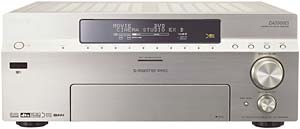
As an aside, when I was recently reviewing new all-digital Sony STR-DA5000ES home theatre receiver, I failed to notice a useful feature: the composite video input signal is converted and made available on both the S-Video and component video outputs, and the S-Video input signal is likewise made available on component video. Saves a lot of TV input switching. This feature is becoming increasingly wide-spread, now also available in models from Onkyo and Yamaha.

Posted in CD, Equipment, Testing | Leave a comment

Price falls on Yamaha RX-Z9 receiver

Now that didn’t take long. Yamaha’s do-everything RX-Z9 home theatre receiver has just fallen in price here in Australia, from $AUS11,999 to $9,999. Perhaps the strong Australian dollar has something to do with it. Or is it getting cheaper overseas as well? Anyone out there want to let me know?

UPDATE (Tuesday, 17 February 2004, 11:29 pm): Reader Tom (yes, the same one as below) writes:

As a regular visitor to avsforum (US), avforum (UK) and beisammen.de (Germany) I think I would have heard something about a price drop. Also checked the Yamaha websites and the RRPs are still the same. It’s clearly a case of mis-marketing here in Australia (what were they thinking!) and even A$10.000 is still way too much.

Current Yamaha RRPs are
US 4499 [$5,700]
Euro 4799 [$7,900]
Pounds 3299.95 [$8,000]

The prices in square brackets on that list are the approximate values in Australian dollars, inserted by me. Hmm, I think Tom has a point.

Posted in Equipment, Value | Leave a comment

Yet another mislabelled DVD

A nice chap from MGM Home Entertainment returned my call this evening regarding my previous post. He seemed quite upset about the error and is looking into it. Excellent response.

Following my discussion with him, I checked out another MGM title which I purchased earlier today as a $AUS14.95 cheapie. This one is Raging Bull. It also carries a ’16:9′ claim on the back. Oh, oh. It’s actually a non-anamorphic transfer. Since it’s 1.85:1, that means 411 vertical pixels of resolution instead of the 554-ish that 1.85:1 in anamorphic widescreen gives you. Also in error on the back: the claim that it has English, German, French, Italian and Spanish audio tracks when, in fact, the disc is English only. It also claims subtitles in 13 different languages. Sorry, it’s in English and English for the Hearing Impaired only.

A possibly interesting point: the volume label for this DVD is 56040D4. Most DVDs have some kind of text title as their volume label, usually the name of the movie. But both this one and The Great Escape have what seem to be hexadecimal number codes. Would this suggest that, like The Great Escape, Raging Bull was also an early release and this single disc version is identical to that one?

Posted in DVD | Leave a comment

False Advertising on DVD covers, or I want my money back!

While many hate pan and scan presentations of widescreen movies on DVD, I am convinced that the worst possible way of presenting a widescreen movie is in non-anamorphic letterboxed format. The best way — and the way the great majority of movies are presented — is in anamorphic widescreen. I shall not buy Titanic until an anamorphic version becomes available.

Consider the Region 4 PAL version of The Great Escape, one of the greatest movies of all time (according to IMDB.com, voted number 70). The version I obtained in late 1999 is presented in letterboxed (ie. non-anamorphic widescreen). The aspect ratio is nominally 2.35:1. Because it is non-anamorphic, the vertical resolution of this DVD is just 322 pixels (I measured this from a screen capture, the presented aspect ratio is actually 2.38:1). If the movie were in anamorphic widescreen instead of letterboxed, you would get 430 pixels of vertical resolution. So this disc delivers just 75% of the possible resolution. In order to overcome the resulting fuzziness, the picture at points has been over-sharpened to produce horribly distracting artifacts.

Now this disc was an MGM one, distrubuted in Australia under an arrangement MGM then had with Warner Home Video. Since then MGM has set up its own distribution arrangements for DVDs in Australia, under the name MGM Home Entertainment Pty Ltd. And has released The Great Escape at the budget price of $14.95 — or at least that’s how much I’ve just paid for it the local supermarket.
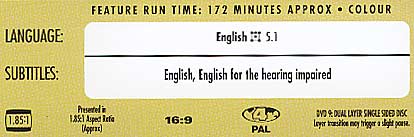
DVD information box for The Great Escape Now why would I buy a DVD that I already have? For better picture quality of course. I am all too aware how DVDs are sometimes mislabelled, particularly with regard to aspect ratio and running time. So I inspected this DVD’s cover very carefully indeed. As you can see, the information box for this DVD is more wrong than right. For example, the time of the movie is shown as 172 minutes, when it is actually 165 minutes (PAL movies run 4% faster than the original theatrical presentation). The aspect ratio is shown by the icon at bottom left and the text to its right as 1.85:1, when it is nominally 2.35:1. But I focused mostly on the next marking to the right: ’16:9′. This is shorthand for 16:9 enhanced (or anamorphic). Whereas 4:3 is used for non-enhanced. So I was very hopeful.

The fact that the same 24 minute documentary was on this version as my previous one made me worry a bit. But then my eye lit on the ‘Language’ box: ‘English 5.1’. The old version is definitely mono, presented in Dolby Digital 2.0. So, I thought, maybe they have remastered it after all! I plonked down my money.

But it turns out that both the ’16:9′ — it is a 4:3 transfer — and the ‘English 5.1’ are totally wrong. Let’s recap: the run time is wrong, the aspect ratio is wrong, the formatting (anamorphic or not) is wrong, and the audio standard is wrong. Not a bad effort, eh?

In fact, the DVD contained within the box is identical to the 1999 version in every way, other than the label. It is identical in organisation, amount of data (7,292,649,472 bytes) and logical disc label (56680D4).

I shall try to establish contact with MGM Home Entertainment Pty Ltd tomorrow and see what they’re going to do about it. Not just my copy, but all the DVDs they’ve distributed with misleading or false information on their covers.

I was also contemplating buying A Fish Called Wanda for the same reasons (the new version also says ’16:9′ on its cover), but now I’m glad I didn’t.

UPDATE (Monday, 16 February 2004, 9:22 am): Reader Tom writes:

The Great Escape (2002 release) is reviewed on Michaeldvd (and three other sites) as 16:9 enhanced & 5.1 encoded. A Fish called Wanda SE is definitely 16:9 enhanced, I just checked my disc. I would expect the single disc version to be the same.

One disc I know of where the 16:9 is definitely incorrect is The Abyss. The original 2 disc version says Widescreen Version 16:9 and is letterboxed, the single disc rerelease says only 16:9 and is, again, the same disc in letterbox. With this one I made the same mistake you did! Bummer.

Unlike Tom, I would expect the single disc version of A Fish Called Wanda to be like my old copy. The information on the back cover on The Great Escape was presumably messed up through confusion with the standards of the SE version. Chances are this was also done with Wanda.

Here are a few others from my collection with incorrect claims on the cover that they are anamorphic:

  • The Abyss (Special Edition) (1989)
  • Beneath Clouds (2002)
  • A Fish Called Wanda (1988) – the original single disc version
  • Goodfellas (1990)
  • The Great Escape (1963) – Discussed above, the original single disc version clearly stated that it was a 4:3 transfer
  • Scent of a Woman (1992)
Posted in DVD | Leave a comment

The Flexible Brain

A couple of months ago I remarked on the misformatted picture of Saddam Hussein:

What is interesting is that the distorted image is still recognisably Hussein. The image processing and facial recognition circuitry in the human brain is truly an amazing thing.

You see this time and again. A home theatre projector works by convincing the brain that the white screen is actually black in parts. The contrast between the brightly projected colours and whites, and those areas masked by the LCD panels or whatever into ‘black’, is expanded by the brain over time so that ‘black’ soon becomes, as far as perception is concerned, black. Likewise, if you see a white cat in a dully-lit room, it will still look white, even though its objective brightness is may be less than the grey blacks produced by an LCD projector.

Our sensory systems have evolved not to give us accurate absolute measurements, but a useful perception of the world around us. That means being able to recognise things in a wide range of circumstances. So that white cat is recognisably white at most light levels, regardless of the background (the exception is where the light level is so low our sight effectively fails).

Likewise, our sight systems include an auto-white-balance system like those in digital cameras. That’s why everything looks normal under incandescent lighting, but if you take a 35mm picture under such lighting on a regular film, the print looks orange (blue-green for fluorescent lighting).

FuturePundit blog has an interesting item on this. A small quote:

The mind has the capability to create an interpreting facility to map between what it sees and how it perceives what it sees. This allows the mind to adjust for the effects of bifocals and other sense-distorting factors. While this capability is adaptive it can sometimes be tricked into creating erroneous interpretations of sensory input.

Posted in Imperfect perception | Leave a comment

The Economic way of looking at things

David Friedman, a scholar in law and economics, has published several fascinating books over the years including one of my favourites: The Machinery of Freedom. His latest (next?) book, Future Imperfect, is available on the Web in draft form, complete with provision for making comments.

My tenuous excuse for mentioning it here is because it does deal with issues of future copyright enforcement. But, less relevantly, I was struck by this superb example of economist-think.

If you really believe that foreign terrorists breaking into computers in order to commit massive sabotage is a problem, the solution is to give the people who own computers adequate incentives to protect them — to set up their software in ways that make it hard to break in. One way of doing so would be to decriminalize ordinary intrusions. If the owner of a computer cannot call the cops when he finds that some talented teenager has been rifling through his files, he has an incentive to make it harder to do so in order to protect himself. Once the computers of America are safe against Kevin Mitnick, Saddam Hussein won’t have a chance. [My emphasis]

An example of how counter-intuitive — but equally how right — much economic thinking can be.

Posted in Computer | Leave a comment

Film ratings, a private alternative

When I was a student at Sydney University in 1976/77 I heard over the air waves for the very first time the F word. It was broadcast on the student-run low-powered experimental University radio station. And its broadcast was somewhat controversial. If I switch on the TV this evening after about 9:30pm, there’s a good chance I’ll see a movie very well studded with the F word, and plenty of others. And that’s free-to-air broadcast TV.

In Australia the classic 1966 movie The Good, the Bad and the Ugly is rated R, which means the DVD can’t be sold to anyone under the age of 18. Many other movies rated R in the 1960s and early 70s have since been re-rated as M (a suggestion that it’s not suitable for under-15s). No doubt GBU would re-rated downwards if resubmitted (I’d guess to M, like so many others).

What these things reflect is the changing (some would say loosening) of that nebulous concept of ‘community standards’.

Now, I see, there is a potentially useful alternative provided by a commercial body called ‘PSVratings’ (presumably based in the US). This Web-based system (~$US20 per year) eschews the twin defects of the major movie ratings systems in the West: those changing standards, and the wobbly value judgements inherent in tying the suitability of programming to different ages. Take Australia’s M rating (probably the closest US version is PG-13) as an example. Why is a particular movie rated M? Is it because it has sex? Violence? Language? ‘Adult concepts’ (whatever they are)? I might not mind my 12 year old seeing a bit of biffo, but recoil at the thought of them seeing casual sex on-screen, even if it is merely suggested rather than shown. Or I might hate depictions of violence and not mind the sex. Or I might want my teens to aspire to conversation with their peers devoid of swearing. Recent movies carry a line or two of text on their ratings as well, clarifying matters somewhat (eg: ‘Low Level Course Language’), but this does little to deal with the changing of standards over time, and involves an inspection of the cover of, say, the DVD. It does not lend itself to inclusion in a database.

PSVratings deals with these issues rather nicely. It uses three scales rather than one: profanity, sex and violence (now you know where the name comes from). It has four colour codes for each scale, with a clear explanation of each on the Web site. So it puts clear objective information into the viewer’s hands.

Will this work? PSVratings makes its money by charging consumers, so there’s always a worry that there’ll be insufficient interest to maintain it. What would be nice is if the film distributors internationally adopted it, at some very small fee (one cent per title per disc, or some fixed amount for rating the movie), and the ratings were then made available to customers for free.

Is it perfect? No, because it is entirely secular. It deals with sex, violence, language and drugs, but not with moral or spiritual issues. Now this last could be a controversial issue, but the fact is that many parents are as concerned with these as they are with the others. Consider religious sensibilities. Even though politically incorrect, some Christians and Muslims object to their children seeing homosexual kissing in PG (suitable for 12 years and over) movies. Others may object to otherwise fine family movies, except that the couples are not married.

These things don’t particularly worry me, but given the huge number of religious people in the world, perhaps a fourth scale would be warranted. Once that could even have a different judging panel constituted by various clergy-people.

No system of rating is perfect, even with my suggested inclusion. But without a doubt an objective system like PSVratings is markedly better than the vague systems generally used.

UPDATE (Wednesday, 18 February 2004, 8:07 am): I am advised by the CEO that the correct name for this organisation is ‘PSVratings (as opposed to PSV Ratings or PSV ratings)’. I have changed the references in this posting appropriately.

Posted in Cinema | Leave a comment

Star Wars finally to come to DVD

The Star Wars goodies It has taken forever, seemingly, but the release of the first three (in chronologically filmed-time terms) Star Wars movies onto DVD has been announced. The date is set for September this year. Here’s part of what the press release has to say:
The STAR WARS TRILOGY tops the list of ‘cinephiles’ most-requested titles never released on the format,’ according to a May 2003 E! Online report. Further, the three STAR WARS TRILOGY films – Star Wars: A New Hope, The Empire Strikes Back and Return of the Jedi — also hold the top three spots on Amazon.com’s ‘most-requested DVDs’ list.Star Wars Episode IV: A New Hope, Episode V: The Empire Strikes Back and Episode VI: Return of the Jedi will be available in a four-disc set that includes a bonus disc filled with all-new special features — including the most comprehensive feature-length documentary ever produced about the Star Wars saga and never-before-seen footage from the making of all three films. Each of the three films in the STAR WARS TRILOGY has been digitally restored and re-mastered by THX for superior sound and picture quality.

‘First and foremost, the DVDs will deliver the very best possible sound and picture and take advantage of everything the medium can offer. On top of that, we are creating added-value material that gets inside the creation of the Star Wars films in a fresh and fun way,’ Ward said. ‘We want watching this DVD collection to be as memorable as seeing the movies for the first time.’

The films of the STAR WARS TRILOGY will be available exclusively as a collection and all three films will be closed-captioned.

Personally I don’t think that it will recapture the feeling I had in the opening minutes of the first time I saw the original Star Wars in late 1977. But that’s only because I now expect what was then a surprise: surround sound. The opening shot of that huge space ship coming from behind me, over my head, accompanied by real Dolby Stereo surround sound, was quite amazing. As for the rest of the movie: seeing space shots done well for, seemingly, the first time since 2001 was great too, even though I was never especially enamoured of the story itself.

Note that last paragraph in the quoted section: if you want just the original Star Wars, you’re out of luck. You’ll only get the boxed set.

One thing I’d like to see, although I doubt that it’s likely, is the original version of the movie without the later digital effects added.

Posted in Disc details, DVD | Leave a comment

Philips backs recordable DVDs in a big way

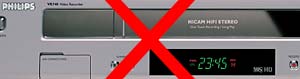
The Australian arm of electronics giant Philips says that it won’t be selling VCRs any more. Philips seems to be the first of what will eventually be many makers pulling out of the field, although I expect that it won’t happen overnight.

Philips drops the VCR Philips is, of course, behind the ‘+’ family of recordable DVDs: DVD+R and DVD+RW. In conjunction with this announcement, Philips says that it is releasing two new DVD recorders. But one of these is not just a recorder. The Philips LX9000R is a DVD/CD etc system with speakers and the works. And it also records DVDs. I think we can expect to see more such systems in the future.

Two major problems with the VCR have been the bulkiness of the cassettes and the incredible complexity of the players’ mechanisms. Integration of the VCR into other devices has consequently been limited to just a small number of combo VCR/TV models. DVDs, though, whether recorders or players, are mechanically the same as CD players. They just have different lasers and software. The rapid price falls in DVD recorders (likely due in large part to the development costs being paid off) ensure that disc players/recorders will likely become ubiquitous over the next few years.

The price drops don’t look like ending in the near future:

SCOTT HOUSLEY [Senior Product Manager of DVD and Audio at Philips]: Probably in the next 12, certainly within the next 12 months at least a 50 per cent decrease in the price of them from where they are today. They will halve and that’s due to very quick global uptake at the moment.

I still don’t expect the ‘+’ and ‘-‘ division to result in a Beta vs VHS style format war. The more likely resolution will be true multiformat DVD recorders. It’s not like the discs themselves are physically different. Already Sony’s models support DVD-R, DVD-RW and DVD+RW, while Toshiba’s model supports DVD-R, DVD-RW and DVD-RAM.

Posted in DVD, Equipment, Recorders, Video tape | Leave a comment