
 I’ve seen them in people’s homes. I’ve seen them in a multitude of shops. I’ve seen them, incredibly, at product launches by major home entertainment equipment manufacturers. And now, once again, I’ve seen one in Iraq, courtesy of CNN.
What I keep seeing is fat faces.
First, I must accept that discussing the issue in this entry in this context is probably inappropriate given the gravity of what has been achieved by the Coalition Provision Authority in Iraq with the capture of Saddam Hussein. I had a tear in my eye with the joy of the moment as I was watching the press conference last night in which the announcement was made. But the fact that these pictures are, more likely than just about any other, to be seen internationally make them a fitting example of this widespread (and, in the great scheme of things, trivial) problem.
The problem is that once some people have a widescreen display (ie. with an aspect ratio of 16:9 instead of the standard 4:3), they seem to live in fear of ever having black bars down the sides of the picture. Instead, they leave the display in 16:9 mode, stretching material recorded in 4:3 mode sideways.
 In those welcome, and pleasingly demeaning, shots of Hussein shown on plasma displays in the press conference, this attitude was in clear evidence. It was obvious that the video footage of the butcher was shot using a 4:3 aspect video camera. But the widescreen plasma displays were left set to widescreen mode, so Hussein’s whole image was distorted sideways, stretched by 33% horizontally.
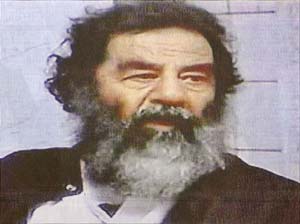
The first picture here shows my scan of the picture from the front page of today’s The Canberra Times, and no doubt similar shots appear on front pages around the world. This is a straight screen capture from the video feed, seemingly not changed in any way other than being cropped at the edges.
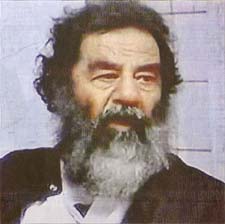
The second picture here shows the same scan, but reduced in horizontal scale by 25% to adjust for the 4:3 to 16:9 widening to which the original picture was subject.
Now, I ask you, which one looks more like Hussein?
What is interesting is that the distorted image is still recognisably Hussein. The image processing and facial recognition circuitry in the human brain is truly an amazing thing.
 Here are my thoughts on the improvements provided by a DVI interface from DVD, compared to component video from the same DVD player. I’ve lifted these from my forthcoming review of the Marantz DV8400 DVD player which will appear in the Australian Best Buys, due out any day now. Please buy it anyway since I contributed 24 other reviews to this one, and this is only an excerpt of the Marantz review.
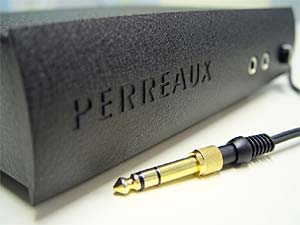 Anyway, my review of Perreaux’s SXH1 headphone amplifier was recently published in Australian HI-FI, occasioning these remarks in the latest newsletter:
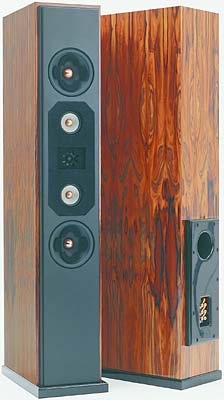 One problem with the picky hi fi person — such as me — is that one gets so damnably familiar with one’s own equipment, and this in itself engenders a kind of dissatisfaction. Take my
 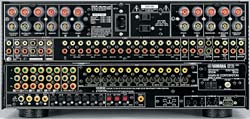 I’ve got some pieces to do for Sound and Image and Geare by Friday next week, including the regular five-way comparison. This time I’m doing high end receivers. This is an auspicious time for this because it’ll include Yamaha’s new $AUS11,999 RX-Z9. Seven x 170 watts, full video conversion from composite, S-Video and component video to each other using Faroudja DCDi electronics, 100MHz video bandwidth to support high definition video switching, and DSP processing (96kHz/24 bit) available for the multichannel analogue inputs. This likely means that the receiver can do bass management and time alignment on these inputs, overcoming the problems with many DVD Audio and SACD players. I’m assured, though, that there is also a bypass for these inputs so SACD purists can rest assured that their precious
 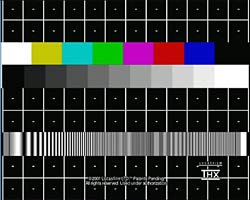 The THX Optimizer is on the newly released Region 4 DVDs of the Indiana Jones trilogy. At last, movies worth owning, which also allow you to adjust your video display device for optimal picture, and your home theatre audio system for optimum sound quality.