I’m back, plus a beaut link

What can I say? Sorry. But now the kids are back at school so I’ll try to be a bit more regular here.

For those interested in the evolution of audio systems used in cinemas, have a look at Nick’s Auditorium, a Belgian site in English, which has some fine explanations of the various audio standards, including a few that have bit the dust along the way. It also suggests that Star Wars was indeed not the first Dolby Stereo movie. It claims this for Lisztomania (albeit without any use of the surround channel), and in full-blown surround the site claims A Star is Born (the Streisand, not the Garland, version of course).

Posted in Admin, Audio, Codecs | Leave a comment

Dictionary of Home Entertainment now (more or less) complete

At long last I have gotten around to finishing off my Dictionary of Home Entertainment. The remaining ‘coming soon’ entries have been defined. A few others corrected. Some misspellings and word repetitions corrected. There are now 380 terms defined. But, by its nature, this will never be complete. If you have any suggestions for additional terms, please email me.

Posted in Admin | Leave a comment

Abbey Road Studios goes DEQX

A few posts ago I mentioned the Sydney-developed DEQX speaker correction system. Now the famed Abbey Road Studios has installed three of the PDC-2.6 systems (each is stereo, so three provide six channels). The studios are apparently not availing themselves of the full capabilities of the system, but primarily using it to correct room-induced anomalies in the bass frequency response of their monitoring system.

It’s extraordinary what digital technology is allowing. It seems that Abbey Road considers this system as the ideal (and therefore ‘high-end’) solution to its needs. Yet a single PDC-2.6 is within the (somewhat extreme) realms of affordability to the high fidelity enthusiast.

Posted in Audio | Leave a comment

Tuggeranong finally fully digital

As of yesterday, the rather tardy Southern Cross Capital 10 TV station finally got its digital retransmission station for Tuggeranong running. Hurrah! That means that all five stations are now available (Prime 7 went on just before Christmas).

It is particularly good that 10 has finally gone digital. Capital was actually the longest-established commercial TV station in Canberra (it got here before I did in the late 60s), but has been tardy in introducing new technology. Thus, incredibly, its analogue transmissions are still delivered with mono sound! So now, at last, we can get The Simpsons in stereo.

Posted in Audio, DTV, HDTV | Leave a comment

A place worth checking for DVI cables and information

International Dynamics has drawn to my attention the DVI Gear Web site at which various DVI cables may be bought. Better yet, follow the ‘Learn About DVI’ link to find some excellent material (some quite technical) on DVI and HDCP.

Posted in Cables, HDMI | Leave a comment

The Onion speaks on religion

Back from a Christmas Holiday with the family, my attention is drawn by my brother to this highly amusing and disconcertingly accurate satire on DVD aspect ratios in The Onion.

Worse, in my view, than ‘full screen’ renditions of widescreen movies are non-anamorphic widescreen versions. The former at least has some element of providing what some people want (those with 4:3 TVs who can’t come to terms with top and bottom black bars). The latter is sheer laziness.

UPDATE (Thursday, 8 January 2004, 1:36 pm): Damn, the Onion link is now dead. It was funny while it lasted.

UPDATE (Monday, 8 March 2010, 12:23 pm): Found the article. Link fixed.

Posted in Misc, Video | Leave a comment

New article posted — home theatre receiver setup

This is a piece I did for Appliance Retailer earlier in the year. It ought to be useful for people who are totally lost when it comes to making the necessary adjustments to their home theatre receivers. Go here.

Posted in Audio, Equipment, How Things Work | Leave a comment

Listen to me on 2UE, Saturday afternoon

Got a call from Sydney radio station 2UE this morning. They want to do a short piece on Saturday afternoon on how to set up your new Christmas DVD player etc. So they’ll be interviewing me Saturday morning and broadcasting it sometime that afternoon. Should be short.

Posted in Admin, How Things Work | Leave a comment

Another Australian Technological triumph

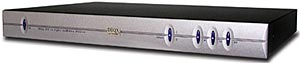
DEQX Calibrated PDC-2.6 A couple of years ago Sydney-based Lake Technology developed audio processing algorithms and hardware to make headphones sound like they’re producing surround sound. The success of this enterprise is attested to by the fact it was was duly licensed by Dolby Laboratories as Dolby Headphone.

Now another Sydney-based company, DEQX, has come up with a SHARC DSP-based digital processor (the PDC-2.6) to pre-process stereo audio signals to counteract deficiences in loudspeakers. This does four different things:

  • equalises the speakers for frequency response and phase uniformity across the audio band
  • eliminates phase discrepancies between the drivers in a two way or three way loudspeaker
  • provides extremely steep crossovers between the drivers, free of phase shift
  • equalises the in-room bass response of loudspeakers

All this is done in the digital domain. Of course, it works at line level, with 96kHz/24 bit analogue to digital converters and 192kHz/24 bit digital to analogue. Or you can feed a PCM signal directly into it to skip the first A/D conversion.

The DSPs that do all the heavy EQ and phase manipulation and crossing over work with 32 bits of resolution. You can either have the unit set up for you by installers, or get the calibration kit which includes Windows 2000/XP software and a calibration microphone.

The reviews quoted on the company’s Web site are extremely positive, and the whole concept is very appealing to me. Those speaker makers committed to the highest quality have to go to herioc lengths to reconcile the often contradictory demands in crossover design: smooth frequency response, minimal phase distortion, steep filter slopes, even impedance across the audio spectrum. One or more of these goals always suffers.

Where did the expertise for all this come from? Today I had a chat on the phone to DEQX CEO Kim Ryrie. Turns out that he was also the man behind the famed Fairlight Computer Musical Instrument back in the mid-70s.

It’s also worth noting that the DEQX system (previously known as ClarityEQ) has been installed in such recording studios as Abbey Road.

Basic prices start at somewhere in the $AUS4,000 to $5,000 region. Precalibration for rooms on supplied detailed specification, using acoustic modelling, comes to around $US900. But you can make do with the internal parametric equaliser to make the necessary adjustments if you like.

Posted in Audio, Equipment | Leave a comment

The CD jukebox syndrome

Get the rockiest CD you can think of where the music thereon was recorded in, say, the 1970s, and play it. Then get just about any modern pop recording. Which is louder? The latter.

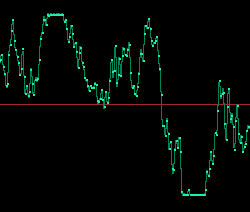
Clipped music, done on purpose This is not for no reason. Apparently most music purchasers want their CDs to be loud. If they are listening to a set of CDs on a CD jukebox, when one that comes up that seems less loud than its predecessor, they are disappointed. Perceived loudness is a function of average playback level, not peak level.

PCM-based digital recording systems, such as the compact disc, have a hard upper limit to the recording level. You cannot go beyond 0dB. That’s all there is to it. So record producers use limiters and dynamic range compressors to bump up the average level without pushing the peaks into ‘red’ territory. Sure, it damages the fidelity of the music, but that’s the price you pay for popularity.

That’s the theory, anyway. But all too often they use hard limiters, which effectively clip the music just as though an amplifier were being overdriven. The picture here is a small part of the wave from of the song ‘Angels Brought Me Here’ from the debut single CD of the winner of Australian Idol, Guy Sebastian. Look at those waveforms! Chopped right off, top and bottom.

The CD mastering was performed by someone called Oscar Gaona at Studios 301, Sydney.

Pleasing everyone, including those who like their music pure, would be possible. Just can the compression and limiting. All the listener has to do if he or she wants it louder is advance the volume control. Is that too much to ask?

Posted in Audio, CD, Music | Leave a comment