Oh, oh … sad news on surround sound music mixes

The SMR Home Theatre web site has a fascinating, if in parts depressing, report on ‘Surround Professional 2002’. What was fascinating was an insight into the surround mixing philosophy of some highly regarded professionals. Here are a few excerpts from one of the pages:

When asked about using the center channel more for vocals, Scheiner recounted his first surround mix, where he had placed the vocals exclusively in the center channel. The singer, whom he wouldn’t name but said was ‘your typically insecure diva’, found out from her manager that it was possible to turn down the other channels and hear just her vocals. Scheiner said he ‘caught hell’ for his mix, adding ‘I’ll never do that again!’ The other panel members agreed completely. …None of them mixed with bass management in mind. When asked about the .1 LFE channel, Botnick said that his mixes were all basically 5.0, but that he ‘always put something, anything, into the sub channel so that the light goes on and people don’t complain that it’s not really 5.1.’ The others laughed in agreement, ‘Gotta light up all the lights!’ …

Sheiner also complained about all the questions regarding use of the center channel, ‘Why does everybody keep bringing that up?’ I explained that it allowed listeners all over the room to point to the same location for the vocalist. For a moment, I saw a light bulb go on over his head as he finally seemed to ‘get it’, but just as quickly dim. ‘Yeah, it makes sense, but I couldn’t do that.’

Depressing indeed.

Posted in Audio | Leave a comment

Before going DVD Audio, how about getting the recording right?

One of the beaut things about DVD Audio is the ability it has to carry six channels of sound at an incredibly high resolution of 96kHz sampling rate and 24 bits of detail. There is no recording format (and here I include SACD) that has the potential to capture the original signal with more accuracy than this (except, possibly, two channel DVD Audio using a 192kHz sampling rate). To get all this data onto the DVD and keep the bit rate down to specification, DVD Audio employs a new non-lossy compression system called MLP, for Meridian Lossless Packing.

But sometimes you have to wonder whether it’s worth it. Consider, for examply, a recent recording of Daniel Barenboim conducting the Berliner Staatskapelle in Beethoven’s 7th Symphony (Teldec 8573-83062-9 — the 8th Symphony is also on this DVD Audio).

This happens to be a superb performance, regardless of format. I had the opportunity to listen to all three formats: CD, Dolby Digital 5.0 and five channel MLP (the subwoofer channel is not used on this recording). All were obviously from the same source recording. The giveaway was as unsubtle as a spurious noise in all three recordings one minute into the 1st movement (possibly a microphone stand being kicked, although it has more the sense of a very brief electrical dropout).

In terms of which sounded the best, I had to give it to 96kHz, 24 bit MLP. This disc was recorded in five channel 96kHz 24 bit, so that is the way in which it ought to be heard. Both the MLP and Dolby Digital surround versions are sensibly encoded with nothing more than ambience in the surround channels. This is excellent. These channels remain inaudible to the ear as individual sound sources, but do add an extraordinary amount of stage depth to the performance.

The reason the MLP came up tops was that it provided a slightly smoother, cleaner and more coherent result than either the DD or CD versions. A breath from a member of the orchestra in the 2nd movement was clearly that, and precisely placed. In both the CD and Dolby Digital versions, the breath sounded as thought it might, perhaps, be a breath but I couldn’t be quite certain.

The CD took second place. The 1st violins sound a little edgier than the MLP version, and there was a lack of the airiness presented by both the MLP and Dolby Digital renditions. Dolby Digital came last, although not by much. It captured much the same air as the MLP, but lacked the fine detail available from the CD and MLP versions.

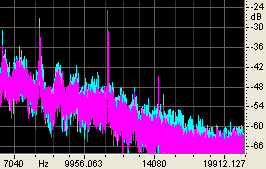
But I have to remark upon the mistake. An amazing mistake. An incredible mistake. In the first movement of the 7th Symphony, in all three versions, a clearly audible 11,140 hertz sine wave makes an appearance, accompanied by a much subtler 7,960 hertz tone, for a few seconds at around 9:30 in. This is decidedly irritating and I have no idea where it could have come from. But it’s there. Don’t believe me? Download this 15 second MP3 (230kB) snippet and listen for yourself. Note also the spectrum analysis. See those high frequency spikes?

I have to wonder how this could happen. Didn’t anyone from Teldec listen to the final product before signing off on it? I can understand such things slipping through on a budget CD, but on a DVD Audio, the main selling point of which is sound quality, this is unacceptable.

I must also comment on the discrimination against those with no more than a standard DVD player. While any deficiences in sound quality must be attributed to Dolby Digital, there really is no reason why a few of the user conveniences couldn’t have been included. The Dolby Digital version is not placed in the usual Title/Chapter heirarchy, so many DVD players find themselves without access to such facilities as on screen display. Further, there seems to be a User Operation Prohibition on the fast forward and rewind keys. If you want to skim back and repeat a section of the music, well … you can’t, and that’s all there is to it. You just have to go back to the start of the track and play it all the way through again.

Posted in Audio, Rant | Leave a comment

The Record Reader

Occasionally you stumble across reports of people capable of performing jaw-dropping feats. Take this guy, for example. Merely by examining the grooves on vinyl records he was able to deduce, with a very high level of accuracy, what the music was — assuming it was classical from the time of Beethoven or later.

I used to own about six vinyl versions of Bach’s Passacaglia and Fugue in C minor. I accumulated that many in pursuit of bass. The theme is largely carried on the pedals and ought to end one several of its cycles on the lowest C pedal. Depending on the design of the organ, this ought to be around 32 hertz and, in the case of organs with really big pipes, 16 hertz.

My collecting came to an end when I finally purchased a Telarc recording. This had a monster organ, 16 hertz fundamental, and a bone-chilling increase in volume towards the end of the Passacaglia. (It’s still available on CD.)

Notably, the modulation of the groove was clearly visible during the loud bits, with (from memory) excursions up to a millimetre or so! Of course, few LPs carried such deep, loud bass for the simple reason that it uses up so much disc surface. Records with such widely spaced grooves were necessarily short in duration.

Posted in Vinyl | Leave a comment

Funny sound mix

Dolby Digital, as I have pointed out, isn’t necessarily 5.1 channels. Many DVDs are two channels (2.0), quite a few offer one channel sound (1.0), and some odd ones even manage 3/1.0 (ie. three front channels, and one surround channel). But this evening I pulled out my Region 4 Warner DVD of Gigi to watch for the first time, and discovered that this is the sole 3/0.0 disc in my collection. What does 3/0.0 mean? It means that the front three channels are used, but there is nothing from the surround channels.

If this seems odd, remember that the movie was released in 1958. That was the days of the on-again, off-again experimentation of film-makers with various forms of stereo sound. This didn’t actually settle down until 1977’s Star Wars, which was the first movie to use Dolby Stereo. In the world of cinema, ‘stereo’ means surround sound. (Dolby Pro Logic is an enhancement of Dolby Surround which, in turn, is the home version of Dolby Stereo.)

In Gigi, this experimentation is interesting, even though a little off-putting. The practice in most movies these days is to feed virtually all the dialogue out of the centre channel, no matter where on the screen the characters happen to be located. In Gigi, though, the dialogue pans across the three front speakers to match the characters’ locations, after a fashion. Unfortunately, the panning sometimes lags, and there is the occasional clunky switch of audio pan during conversations between characters.

Another obvious audio problem is the break in recording continuity as Gaston reconsiders Gigi’s development. He is in front of a fountain and suddenly there’s a switch from location to studio recording.

Also off-putting was the Cinemascope filming, in parts at least. The lens produced considerable distortion at the edge of the widescreen picture. Forgivable, perhaps, except when characters wander into the zone of distortion and suddenly became remarkably thin.

Posted in Audio, Cinema, DVD | Leave a comment

DVD Audio Bonus Groups

I’m in the middle of reviewing a pentuplet of DVD Audio players and, thinking I knew it all, stumbled across something new to me: DVD Audio bonus groups. Now the DVD Forum, in its wisdom, chose to abandon the familiar Title/Chapter nomenclature from DVD Video when specifying DVD Audio. Instead it uses Group/Track as the primary divisions between material, with Page for different video screens capable of being shown without interrupting the audio flow (for example, you might be able to choose between lyrics and photos, while the music plays on regardless).

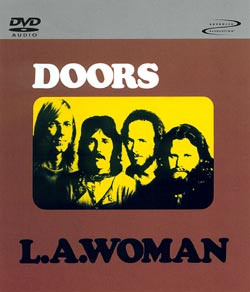
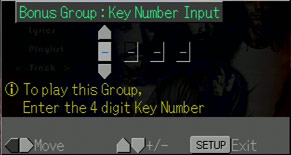
I had previously noticed on some DVD Audio players a ‘Bonus Group’ setting on the Setup menu, but hadn’t thought much of it. In the current round, though, I chose The Doors L.A. Woman to audition a player. Checking its navigation facilities, I keyed through the four Groups available on the disc (Group 1 is the surround mix, Group 2 is the stereo mix, Group 3 is the film clip in Dolby Digital, and Group 4 is the Elektra Entertainment logo). But there is also a Group 5, which is apparently a ‘Bonus Group’. See the screen shot below, which shows the password entry panel that is brought up when you navigate to this Group using the ‘Search’ key on an Onkyo DV-SP800 DVD-V/DVD-A/SACD player. There appear to be no menu or other links to this Group on the disc.

Googling around has no information specific to bonus groups on any discs, although a PDF format DVD Forum recommendation for DVD Audio, dating from early 2000, says that a bonus group, alternatively known as a ‘hidden group’, should be accessible using a four digital number (although it does not insist on a link to the group within the disc’s menu system).

What is does recommend is information:

3.2 For Disc Jacket and Booklet, etc.
When a disc has a Bonus Group,

  • Some notation for existence of the Bonus Group should be described on Disc Jacket, etc.
  • Indication for the Group number of the Bonus Group should be described on Disc Jacket, etc.
  • Instruction how to get Key Number should be introduced on Disc Jacket, etc.

Well this disc does not have any indication on its jacket that there is a bonus group. It is quite possible that the addition of a bonus group was unintentional. Sometimes, particularly in the early days of mastering a new technology, the people involved have trouble working how to turn certain facilities off. For example a number of early Roadshow titles in Australia have silent MPEG audio tracks because, apparently, the mastering people thought that there was no facility to completely omit MPEG (maybe this was the case with their early software).

The whole concept of a bonus group is a bit confusing anyway, since quite a few DVD Audios have ‘bonus tracks’ (sometimes in their own groups!) If this is used, the better terminology would be ‘hidden group’.

Looking through my DVD Audio collection, I now discover that the following discs have bonus groups (although no mention of such on their jackets):

The Corrs: In Blue (Group 4)
Deep Purple: Machine Head (Group 6)
The Eagles: Hotel California (Group 4)
Emerson, Lake and Palmer: Brain Salad Surgery (Group 4)
B.B.King & Eric Clapton: Riding with the King (Group 2)
Queen: A Night at the Opera (Group 9)

The problem is, I don’t want to key through the average of 5,000 numbers that it would take to crack the code on each! Assuming, even, that there is a valid code.

UPDATE (Wednesday, 30 July 2003, 9:20 am)DTS responds.

Posted in Audio, Disc details, DVD | Leave a comment

Panasonic goes digital

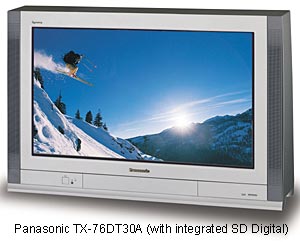
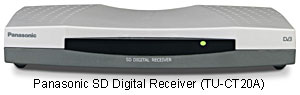
Meanwhile, Panasonic has gone digital. It’s introducing two digital set top boxes and a 76cm widescreen TV with integrated Standard Definition digital tuner (the TX-76DT30A). This $4,399 TV is available now.

The cheaper of the two set top boxes supports SD only (model TU-CT20A) and, at $549, seems to be a little overpriced in that it lacks digital audio outputs (you can get the RCA and Zinwell boxes, with similar capabilities, for quite a bit cheaper). The TV seems a bit pricy too. While it’s a good 100 hertz 76cm widescreen model, it doesn’t get the ‘Fine Pitch’ treatment of the other new Panasonic model. Add the $3,629 of this model to the $549 of the SD box and you get $4,178, or more than $200 cheaper


than the integrated model. On the other hand, if well-implemented, the integrated TV ought to deliver better quality pictures from digital broadcasts, because it should not suffer the extra pair of digital to analogue, and analogue to digital conversions inherent in set top box connections.

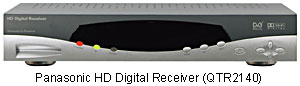
The other set top box (model QTR2140) is a welcome addition to the line up since it competes in the very limited high definition field which, until now, has been exclusivelyDGTEC‘s. This supports up to 1080i and has a full set of digital audio outputs. It will sell for $989. Both set top boxes are scheduled to be available in August 2003.

Posted in DTV, Equipment, HDTV | Leave a comment

Higher resolution CRT TVs appearing

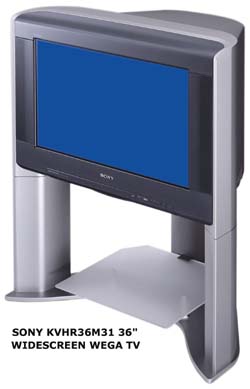
Sony will shortly (September 2003 in Australia) be introducing an 86cm widescreen CRT TV (model KVHR36M31) which it says will increase the number of slits in its grill by 65%, ‘making this the aperture grill with the highest number of vertical slots on the market.’ Since Sony is the principal producer of aperture grill-based TVs (aka Trinitron, which was invented by Sony in the late 60s), this isn’t surprising. But it is welcome. Sony calls this ‘Super Fine Pitch’. I’ll be getting one to review in September. I’m kind of looking forward to it, except for the weight. Such large CRTs usually weigh in excess of 60kg.

Panasonic has also introduced something along similar lines, except it uses the more traditional shadow mask in its TV tubes. Called ‘Fine Pitch’, the TX-76PW150A only offers ‘30% more phosphor dots’ than usual. Since this is a 76cm model, a greater increase in resolution is probably not warranted.

Both these models represent real advances. The last few years have seen some interesting digital processing coming into TVs, but they have always been held back by tubes that offered no physical increase in resolution. This overcomes that.

Both TVs offer 100 hertz scanning, which is PAL’s answer to progressive scan. Panasonic says its TV supports 576p input (but nothing about 480p, given the number of NTSC-only progressive scan DVD players there are out there). Sony says that its TV incorporates DRC-MF (‘Digital Reality Creation – Multi-Function’). While its press release implies support for high definition input (‘it also sets a new standard for viewing High Definition (HD) broadcasts’), it doesn’t actually mention what, if any, input standards it supports.

UPDATE (Thursday, 17 July 2003, 7:16 pm): Sony gives me some good news and some bad news. The good: the KVHR36M31 will accept input sources delivering 480p, 576p, 720p and 1080i. Yippee! The bad: the TV doesn’t weight 60kg, but 90kg. Gonna need a hand to get that up on my stand.

UPDATE 2 (Friday, 18 July 2003, 5:03 pm): Panasonic advises that this TV supports 480p (ie. progressive scan NTSC) input as well as 576p

Posted in Equipment, Video | Leave a comment

Wow oh wow … but I’m still an idiot

Just a couple of days after I purchased an Australian DVD release of the silent classic Metropolis, I read of a new, restored version on James Lilek’s glorious ‘The Bleat’. Taking mercy on the man (and as just a tiny downpayment on my appreciation of his world-beating writing), I used his link to purchase a copy from Amazon. Oh what a twit I am!

I had read that this was beautifully restored in Germany, so of course I went and bought the US version. The German version is PAL, and enjoys 576 lines of resolution. The US version is NTSC, and enjoys (hah!) just 480 lines, plus all the interlacing problems NTSC produces. I should have hit the UK or German versions of Amazon to make my purchase. Oh well.

Despite this silliness on my part, the Kino Video version of Metropolis is better than the local version in too many ways to fully specify. But here are a few of them. First, the local Force Video version comes from an NTSC video source anyway, so it suffers even more intractable interlacing problems (NTSC to PAL conversions, unless done very cleverly, result in the NTSC interlacing being spread over an even higher proportion of frames). Secondly, the Force Video version looks like it comes from about a tenth generation copy of the film.


While here I will show you some differences between the single-frame quality, you can take my word for it that in addition to losses and confusion in the film’s structure, the Force Video version jitters around the frame in a truly off-putting way, and suffers much more brightness variation (yes, some remains in the restoration).

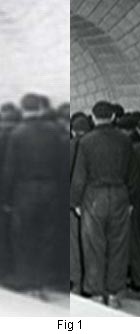
But it is in seeing what is going on that the restored Metropolis excels. Look at Figure 1. The detail on the left is from the Force version, that on the right is from the Kino version. Actually, that’s not quite right. As we shall see shortly, the Force version is so heavily cropped that details in the Kino version are quite a bit smaller. So to make the comparison more apt, I scaled up the right-hand detail in linear size by 26% so that there’d be a rough match. It’s actually a little sharper before the size increase. Remember, too, that even before this I scaled up the image from 480 to 540 pixels vertically (the PAL version was downsized from 576 to 540 — the relevance of 540 is that it gives the correct aspect ratio when the horizontal resolution is 720 pixels; 720*3/4=540).

Part of this might be due to the DVD encoding. The Kino version appears on a dual layer DVD and gets an average bit rate of 6.22 Mbps, and still well over 5 Mbps even after the audio tracks are subtracted. The Force version has to make do which what must be some kind of low-record for DVD encoding: just 2.8 Mbps (around 2.6 Mbps for video only) — indeed, this is the lowest rate for the feature of any disc in my collection. There really wasn’t any excuse for such a low bit rate, because of the 4.7GB capacity of a single layer disc, only 2.87GB has been used. The bit rate could easily have been bumped up by 50%.

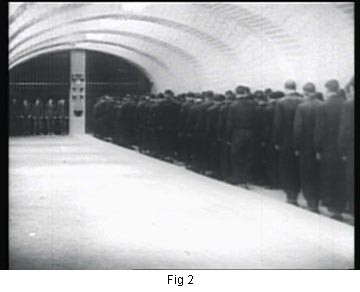
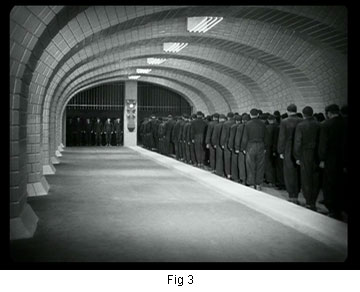
Now Figures 2 and 3 are matching frames from the movie (near the start). The most obvious difference is in the brightness and contrast. To the extent that any detail remained in the Force version, it has been washed out by overexposure. Look at the overhead lights. You can count the fins on the Kino version, but they are mere indistinct blobs of light on the Force version.

Then there is the focus, which allows a huge amount of detail on the Kino version, almost none on the Force version. Count the bricks! See the dirt smudges on the overalls.

And there is the framing as well. A huge amount of the left and top of the frame has been chopped in the Force version. So much, that it looks like a different camera angle. Yet by showing the left hand side of the arch, the Kino version emphasises the mechanistic look of the workers, being cycled through the work/rest cycle as though mass, indistinguishable parts in a machine.

You won’t be disappointed with the Kino version (which uses the original score in decent Dolby Digital 5.1 sound). But if you are in a PAL country, get the PAL version which, I expect, will be even better.

WARNING: The Kino version of Metropolis is Region 1 encoded. The Force Video version will work in all Regions.

Posted in Disc details, DVD | Leave a comment

Hurry up Digital Video Interface!

Did you know that the picture quality available from DVD is crippled? And it’s all thanks to the analogue connections. It doesn’t matter whether your DVD player puts out progressive scan or interlaced video, you are not getting all the horizontal resolution on the disc.

The video is held on a DVD at a resolution of 720 pixels across by 576 (PAL) or 480 (NTSC) pixels vertically. But the analogue connection standards — even if you use a component video connection — support only 500-ish pixels horizontally. This can’t be increased within the standard because the analogue signal will not carry more data. The scanning frequency is fixed. Progressive scan doubles the scanning frequency, but it uses this to double the number of lines sent, not double the amount of information on each line.

For some time a way around the crippling has been on the horizon. That’s the introduction of the DVI-D interface (Digital Visual Interface – Digital*). Already available on a number of high-end computer video cards and an increasing number of high end home theatre projectors and plasma displays, it has thus far appeared on just one DVD player: the Bravo D1. DVI-D promises an increase in horizontal resolution of up to 44% (compared to PAL’s clearly visible 20% boost in resolution over NTSC).

There are other advantages to a direct digital connection as well. It avoids the digital to analogue conversion in the DVD player, and the subsequent analogue to digital conversion in the display device. To quote from a review of the Bravo D1:

When using the native 480p output, the Bravo D1 delivered an image that was very subtly sharper than the Denon [DVD-3800]. But more importantly it was noticeably more stable with fewer artifacts and less jitter.

The problem has been that the DVD Forum is concerned that allowing full-resolution digital video output would facilitate DVD piracy. Yeah, sure. As though the pirates who sell DVDs with ‘This is a promotional copy’ banners dancing across the bottom of the screen, or movies captured with a video camera placed in a cinema, give a stuff about quality. Still, the Forum’s nerves have been somewhat settled by the development by Intel of the High-bandwidth Digital Content Protection (HDCP) encryption protocol. Basically, this will allow a DVI-D-equipped DVD player to handshake with a similarly equipped display device, establish an encryption key, and then feed it the signal at full resolution in uncompressed digital format.

Actually, there is one way of watching full resolution DVD at the moment: that’s using a computer-based DVD player. And this allows me to demonstrate the actual differences in the picture quality. I grabbed a frame from the Superbit version of The Fast and the Furious (chosen because of its very high video quality). The picture below shows at the top a detail from the original frame (captured at the original resolution of 720 by 576 and then Photoshopped to 1024 by 576 to show the correct aspect ratio), and at the bottom the same detail, first Photoshopped to 500 by 576 and then to 1024 by 576. The bottom one thus approximates the quality that you actually receive using an analogue connection.

The detail is part of the background from the car performance shop interior, just a 150 by 50 pixel slice, which I have doubled in size to make the differences clearer on screen (remember, if you use a projector the picture will look quite large).

Look first at the vertical slats to the right. Notice how clearly defined and evenly spaced they are in the top shot, and how fuzzy and uneven they are at the bottom.

Then look at the right hand blue tank. See how the highlight has fuzzed up and almost disappeared. Then look just to the right of the white pole. Near the top you’ll see two very fine dark vertical lines. At least, you’ll see them if you look at the full-resolution top shot.

Where you won’t see them is in the 70% resolution bottom shot.


* The ‘D’ on the end of DVI-D is to distinguish it from DVI-A. The standards designers have sensibly allowed the physical connections to be capable of handling analogue signals as well as digital, using different cables. Obviously, only a DVI-D connection will realise the higher resolution. The DVI-A capability is there just as a convenience.

Posted in HDMI, Video | Leave a comment

Does downloading music cost CD sales?

Tim Blair links to a story from The Scotsman which claims ‘research’ shows that people ‘who illegally download their favourite tracks from the internet still buy albums in the shops’.

Hmmm.

This seems to be a case of asking people questions, rather than examining whether they actually did go out and make the subsequent purchases. This is common in such research. But people’s statements of intentions and what they actually do frequently diverge significantly.

So, do I support the RIAA’s chasing of music file sharers? Not at all. I think the oft-made statement that copying music is ‘theft’ is ridiculous — the act of theft involves not just obtaining something, but depriving the person from whom the theft is made of that something’s use. I think that industry figures of the amount ‘lost’ due to file sharing and other copyright infringements are ludicrous — it is incredibly naive economics to believe that if a person couldn’t burn a CD for a cost of $1, they would go out and buy it for $25.

Yes, surely some people who sample music from the Internet go and buy the CD when they’ve discovered they like it. But how many?

The biggest hit to CD sales is not from Internet downloads — which provide odd tracks of uncertain quality — but copying whole CDs from friends. Doing this delivers better quality and is cheaper and far faster than going the Internet route, can’t be tracked using Internet technology, and can’t be protected against while the CD continues to exist.

Posted in CD, Copyright, Music | Leave a comment